Crowdsourcing 2026: What AI Experts Agree Will Happen in Customer Experience and Customer Operations

A comparison of five 2026 predictions, grounded in 2025 developments

If 2024 was the breakthrough and 2025 was the pilot-to-production scramble, 2026 looks like the year customer operations gets serious about making AI repeatable. This article reviews late-2025 predictions from major analysts and platforms, then compares where they converge and where they differ to estimate what is most likely in 2026. This article synthesizes late-2025 research and 2026 outlooks from Salesforce, McKinsey & Company, Zendesk, Deloitte, Forrester, Gartner, and Microsoft.
What changed materially in 2025 (the baseline for 2026 predictions)
AI moved from “nice-to-have” to a top operating priority in service; many organizations report meaningful case handling by AI already.
Adoption broadened, but scaling remained uneven; workflow redesign and change management emerged as the gating factors for value capture.
Customer expectations rose in step with AI availability, especially for 24/7 support and seamless continuity across channels.
Trust, transparency, and security became board-level constraints as autonomy increases and AI-enabled fraud pressure grows.
Bottom line for 2026: 2025 created proof points (real deployments, measurable automation) and exposed bottlenecks (data readiness, workflow redesign, governance, and security).
The five predictions for 2026
1) Agentic AI moves from demos to a real operating model
Expect more service workflows where AI does not just suggest answers - it completes steps (authenticate, update records, issue refunds, schedule callbacks) with human supervision for exceptions. Forecasts differ on pace: some expect broad investment in agentic AI by end of 2026, while others warn that 2026 will feel like operational hardening and that quality may dip during the transition.
2) Orchestration beats point tools; “service AI ops” becomes a discipline
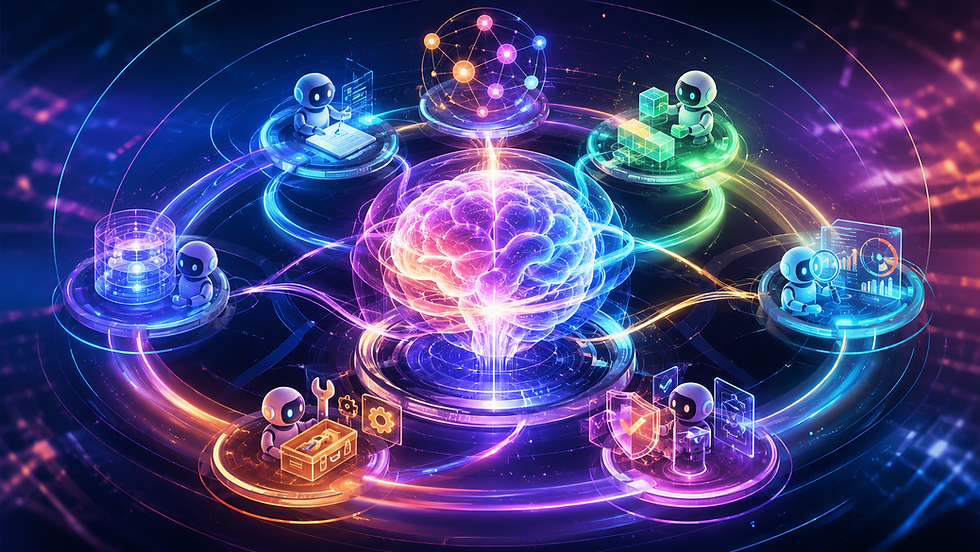
Winning teams will connect routing, knowledge, QA, workforce management, analytics, and back-office workflows into one orchestrated system - and manage it like a product. Success metrics shift from simple containment to business outcomes (resolution time, repeat contacts, retention, cost-to-serve).
3) Data quality and “experience memory” becomes the bottleneck (and the differentiator)
Personalization at scale requires trustworthy context that persists across channels and time. Teams that fix identity resolution, knowledge freshness, permissions, and governed data access will unlock safer autonomy and better customer outcomes.
4) Multimodal continuity raises the bar for “good service”
Customers increasingly want to communicate naturally - text, screenshots, photos, and short videos - without restarting the conversation. This pushes platforms to unify threads, context, and handoffs across bots and humans.
5) Trust, transparency, and security become first-class product requirements
As autonomy increases, failures become costlier. Governance (policy, audit trails, access control, evaluation, human override) stops being a side project and becomes part of the core architecture. Fraud defenses, especially for voice and identity verification, become central to customer operations.
Table 1 - Commonality matrix (where expert predictions overlap most)
2026 prediction theme | Overlap strength | Why it matters most in CX/ops |
Agentic AI in production | High | More end-to-end automation; new operating roles |
Orchestration + workflow redesign | High | Prevents brittle deployments and “AI spaghetti” |
Data trust + experience memory | High | Enables personalization and safe autonomy |
Trust/safeguards/security by design | High | Reduces operational and reputational risk |
Multimodal continuity | Medium | Differentiates experience; increases complexity |
Table 2 - A 2026 “do this next” checklist for CX leaders
Next step (Q1-Q2 2026) | Outcome |
Inventory top contact drivers; map “safe-to-automate” vs “human-required” | Focus AI where it will hold up |
Fix knowledge + data access (freshness, permissions, provenance) | Fewer hallucinations; higher containment |
Build an AI ops cadence (QA sampling, drift checks, playbooks, KPIs) | Repeatable quality at scale |
Implement guardrails (human override, role-based access, audit logs) | Safer autonomy |
Design for multimodal continuity and clean handoffs | Higher CSAT; lower recontact |
Conclusion
The “wisdom of experts” for 2026 is not that models will magically solve service. It is that agentic AI will expand, but the winners will treat CX AI like an operating system: orchestrated workflows, trustworthy memory, and guardrails by design.
References
Salesforce. (2025, November 13). Salesforce 2025 State of Service report. Salesforce Newsroom. https://www.salesforce.com/news/stories/state-of-service-report-announcement-2025/
McKinsey & Company. (2025, March 12). The state of AI: How organizations are rewiring to capture value. https://www.mckinsey.com/capabilities/quantumblack/our-insights/the-state-of-ai-how-organizations-are-rewiring-to-capture-value
Zendesk. (2025). Zendesk CX Trends 2026. https://cxtrends.zendesk.com/
Deloitte. (2025, November 17). TMT Predictions 2026: The AI gap narrows but persists. Deloitte Insights. https://www.deloitte.com/us/en/insights/industry/technology/technology-media-and-telecom-predictions.html
Forrester. (2025, November 10). Predictions 2026: AI gets real for customer service, but it's not glamorous work. (K. Leggett). https://www.forrester.com/blogs/2026-the-year-ai-gets-real-for-customer-service-but-its-not-glamorous-work/
Gartner. (2025, November 14). Strategic predictions for 2026. https://www.gartner.com/en/articles/strategic-predictions-for-2026
Microsoft. (2025, December 8). What's next in AI: 7 trends to watch in 2026. Microsoft Source. https://news.microsoft.com/source/features/ai/whats-next-in-ai-7-trends-to-watch-in-2026/